

 English
  中文简体
中文简体  Español
  Deutsch
When choosing a sandwich maker, the most important features to look for are plate type, wattage, plate size, non-stick coating quality, heat control, and safety features. Getting these right means the difference between a versatile kitchen staple and a gadget that collects dust. This guide breaks down every essential sandwich maker feature so you can make a confident, informed purchase.
1. Plate Types: The Most Critical Choice
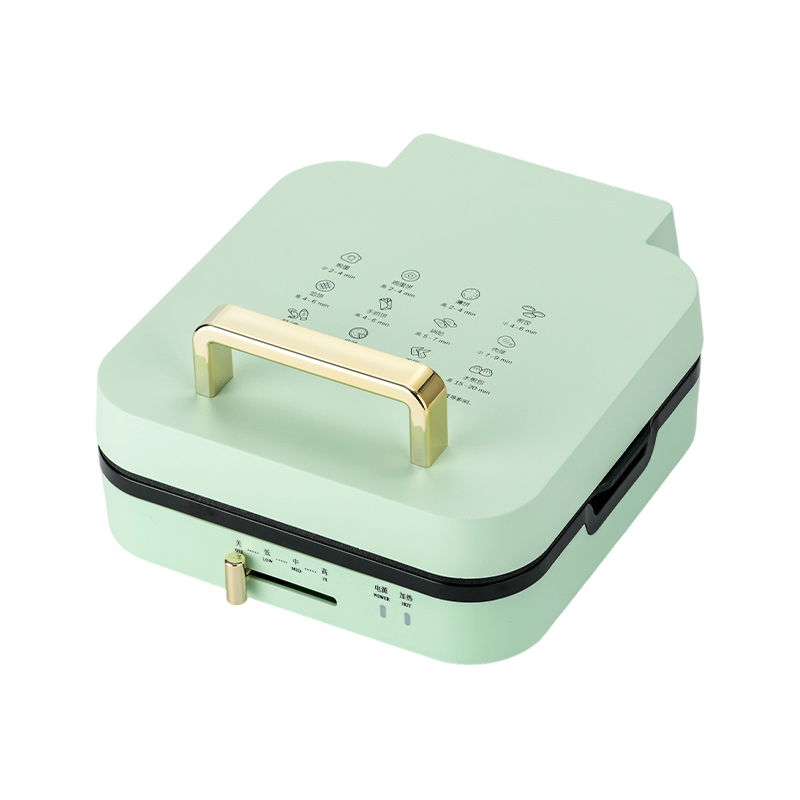
The type of cooking plates determines everything from texture to versatility — it is the single most important sandwich maker feature to evaluate before buying. Most models fall into one of four plate categories.
Diagonal / Triangular Plates
These classic plates press and seal sandwich edges, cutting the bread diagonally and creating two perfectly sealed triangular pockets. They are ideal for sealed toasties and prevent fillings from spilling. Most entry-level models (priced between $20–$45) use this design. If you mostly make traditional toasted sandwiches, this plate type is all you need.
Grill / Ribbed Plates
Ribbed plates create raised grill marks on bread and meat, mimicking a panini press or contact grill. They distribute heat more efficiently across the cooking surface and are better suited for thicker sandwiches, wraps, and meats. Models with grill plates typically reach temperatures of 180–230°C (356–446°F), making them faster for browning.
Flat / Smooth Plates
Flat plates produce an evenly browned, non-ridged surface — best for quesadillas, French toast, and thin sandwiches where you want uniform contact. Some users prefer flat plates for eggs or pancakes, extending the machine's usefulness beyond sandwiches.
Interchangeable Plates
Interchangeable plate systems offer the most versatility, letting you swap between triangular, grill, and flat plates in seconds. Mid-range models with this feature typically cost $55–$120. If you plan to cook a wide variety of foods, removable interchangeable plates represent the best long-term investment.
2. Wattage & Heating Power
A sandwich maker's wattage directly determines how fast and evenly it heats — look for at least 700W for reliable results. Low-wattage models (under 600W) take 4–6 minutes to preheat and often produce unevenly toasted bread. Models rated at 900W or above preheat in under 90 seconds and cook a sandwich in roughly 2–3 minutes.
For household use, 750W–850W is the sweet spot: powerful enough for quick cooking, but not so energy-hungry that running costs add up significantly. Commercial-grade units often exceed 1,200W, reducing cook times to under 90 seconds per sandwich — useful in high-volume settings but unnecessary for most home kitchens.
- Under 600W — Slow preheat (4–6 min), uneven heat distribution. Avoid.
- 600W–800W — Standard household range. Preheat in 2–3 min. Adequate for daily use.
- 800W–1,000W — Fast preheat (under 90 sec), excellent for thick bread and meats.
- 1,000W+ — High output for frequent or semi-commercial use.
3. Plate Size & Capacity
Choose a plate size that matches your typical serving need — a single-serve unit wastes time for families, while an oversized maker hogs counter space for a solo user. Sandwich maker plate sizes fall into three practical categories:
- Single-sandwich (2-slice): Roughly 20×20cm cooking surface. Compact, low energy use. Best for one person.
- Dual-sandwich (4-slice): Around 28×25cm. Produces two sandwiches simultaneously — ideal for couples or small families. Typical cook time: 3–4 minutes.
- Family / large-format: 30cm or wider. Accommodates oversized artisan bread and thicker fillings. Preheat time increases by 30–60 seconds compared to smaller units.
Also look for a floating hinge design, which allows the top plate to adjust its angle and accommodate bread slices up to 3–4cm thick without squashing the filling. Fixed-hinge models are limited to standard sandwich thickness and will struggle with stuffed focaccia or bagels.
4. Non-Stick Coating Quality
A high-grade non-stick coating is non-negotiable — inferior coatings chip within months, contaminate food, and make cleaning a chore. Here is what to look for:
PTFE (Teflon-Grade) Coating
The most common non-stick material. High-quality PTFE coatings are durable, require minimal oil, and are easy to wipe clean. Look for models that specify a multi-layer coating (2–3 layers) — single-layer PTFE scratches easily and degrades within 12–18 months of regular use.
Ceramic Non-Stick
Ceramic coatings are PTFE-free and generally considered a safer option for high-heat cooking. They are scratch-resistant and handle acidic fillings (like tomatoes) better than basic PTFE. The downside: ceramic coatings can lose their non-stick properties faster if subjected to sudden temperature changes or abrasive cleaning.
What to Avoid
Avoid sandwich makers with a single thin non-stick layer, no mention of coating material in the product specifications, or coatings that feel rough or uneven right out of the box. A quality non-stick surface should feel uniformly smooth and glossy, and a gentle wipe with a paper towel should glide across it with no resistance.
5. Heat Settings & Temperature Control
Adjustable temperature control transforms a sandwich maker from a one-trick appliance into a multi-use cooking tool. Basic models operate at a fixed temperature (usually around 180°C), which is fine for standard white bread but burns thicker whole-grain loaves or undercooks denser fillings like chicken.
Mid-range and premium models offer:
- 2–3 heat settings (Low / Medium / High): A solid improvement over fixed temperature. Low (~150°C) suits delicate fillings like brie and jam; High (~220°C) works for meats and panini-style pressing.
- Thermostat dial (continuous adjustment): Offers the most precision. Look for a range of 120–240°C to cover every use case.
- Digital temperature display: Present on premium models ($100+). Eliminates guesswork and is especially useful for recipes requiring exact temperatures.
Ready indicator lights (or audible beeps) are a related must-have feature. A green "ready" light tells you the plates have reached the set temperature before you place your sandwich — this prevents undercooked results and is absent on the cheapest models.
6. Safety Features
Essential safety features in a sandwich maker include cool-touch handles, non-slip feet, and automatic overheat protection. These are not luxury extras — they prevent burns and protect the appliance from damage.
- Cool-touch exterior & handle: The outer casing should remain below 60°C even during operation. Plastic or silicone-grip handles prevent accidental burns when opening the lid. Always test this claim by checking user reviews, as some cheaper models advertise cool-touch handles that still transmit significant heat.
- Non-slip rubber feet: Four rubber feet keep the unit stable on smooth countertops. Without them, a sandwich maker can slide during use — a real hazard when steam and pressure build up inside.
- Overheat cutoff: An internal thermal fuse or cutoff switch automatically powers down the unit if internal temperature exceeds a safe threshold. This protects both the user and the machine in the event of a malfunction or if the unit is accidentally left on.
- Cord storage: A cord wrap or storage clip on the underside keeps the power cable tidy and reduces wear on the cable sheath over time.
- Locking latch: A lid-lock mechanism is essential for safe upright storage and useful when transporting the maker.
7. Ease of Cleaning
Removable, dishwasher-safe plates make cleaning dramatically faster and encourage more frequent use. Fixed non-removable plates are difficult to clean thoroughly, especially when melted cheese or jam seeps into the hinge area.
Key cleaning-related features to check:
- Removable plates: Plates that detach with a click or press mechanism can be washed under running water or placed in the dishwasher. This single feature reduces cleaning time from 10 minutes to under 2 minutes.
- Drip tray: Some models include a small drip tray at the front edge to catch excess butter, oil, or melted cheese. This prevents mess on your countertop and simplifies post-cook cleanup.
- Deep grooves & hinge gaps: Avoid designs with deep exposed grooves around the hinge — these trap crumbs and burnt residue that are nearly impossible to clean without a brush.
- Smooth exterior surfaces: A casing with minimal seams and recesses is far easier to wipe down. Textured or ridged exterior panels collect grease over time.
8. Build Quality & Design
Durable materials and a well-engineered hinge mechanism are the hallmarks of a sandwich maker built to last. A unit made from heat-resistant ABS plastic with a stainless-steel accented top panel will generally outlast one made entirely from lightweight polypropylene.
Vertical Storage Capability
Many modern sandwich makers can stand upright for storage, cutting their countertop footprint by up to 70%. This is particularly valuable in small kitchens. Ensure the locking latch holds the unit securely in the vertical position before purchasing.
Cable Length
A cable length of at least 90cm (ideally 1.2m) allows flexible placement on the countertop without straining near a wall socket. Short cables (under 75cm) force the unit to sit uncomfortably close to the socket, creating a tripping hazard and restricting placement.
Weight Considerations
Compact single-sandwich makers typically weigh 0.8–1.2kg, while dual-sandwich or interchangeable-plate models range from 1.5–2.5kg. Heavier units with stainless-steel components tend to be more stable during use but are less convenient to move in and out of storage.
9. Sandwich Maker Feature Comparison at a Glance
Use the table below to quickly compare which features appear at each price tier so you can set a realistic budget before shopping.
| Feature | Budget ($20–$45) | Mid-Range ($45–$90) | Premium ($90–$150+) |
| Plate Type | Fixed triangular | Fixed grill or triangular | Interchangeable (3+ types) |
| Wattage | 600–700W | 750–900W | 900–1,200W |
| Heat Control | Fixed temperature | 2–3 heat settings | Thermostat dial or digital |
| Non-Stick Coating | Single-layer PTFE | Multi-layer PTFE | Multi-layer PTFE or ceramic |
| Removable Plates | Rarely | Some models | Standard |
| Ready Indicator | Basic light only | Dual indicator lights | Digital display / beep alert |
| Floating Hinge | No | Some models | Yes |
| Overheat Protection | Basic thermal fuse | Auto cutoff | Auto cutoff + indicator |
| Vertical Storage | Rarely | Some models | Usually yes |
| Drip Tray | No | Some models | Yes |
Table 1: Sandwich maker features by price tier — a general guide based on market survey data (2025–2026). Individual models may vary.
10. Frequently Asked Questions
Quick Summary: Top Features to Prioritize
- Plate type — Choose interchangeable if you want versatility; triangular for classic toasties.
- Wattage — Minimum 750W for consistent, fast results.
- Removable plates — The single most practical quality-of-life upgrade.
- Non-stick quality — Multi-layer PTFE or ceramic; avoid single-layer coatings.
- Heat control — At least 2–3 settings; thermostat dial preferred.
- Safety features — Cool-touch handles, non-slip feet, and overheat cutoff as a minimum.
- Floating hinge — Essential if you use thick bread or generous fillings.
- Safety certification — CE, UL, or regional equivalent required.