

 English
 中文简体
 Español
 Deutsch

A breakfast sandwich maker is a countertop appliance that holds the bread, the egg, the cheese and the meat in separate stacked tiers and cooks all of them in one closed cycle. That is the whole idea, and it explains the appeal: a sandwich with a set egg and melted cheese reaches the plate in four to six minutes, using one appliance instead of a frying pan, a toaster and a spatula juggling act.
The trade-offs are just as concrete. It will not sear a steak, it is limited to the diameter of its ring or plate, and a sandwich stacked too tall will compress rather than cook. What follows covers how the machine actually works, which configurations matter, where buyers get caught out, and what to inspect before spending money.
How the Stacked-Tier Method Cooks a Sandwich
The machine cooks by isolating each component in its own layer, then letting heat and gravity assemble the sandwich at the moment you open the lid.
The classic design has three levels: a lower plate that holds the bottom slice and the cheese, a middle plate with a circular ring that holds the egg, and an upper plate that warms the top slice. Heat reaches the egg from both above and below, which is why the white sets in about three minutes without flipping. Simpler clamshell models drop the middle tier and rely on two plates only; they still cook fast, but the egg has to be pre-cooked or placed inside the bread.
- Preheat the closed unit for one to two minutes. Starting cold gives a pale, limp bottom slice.
- Oil the lower plate lightly, lay the bottom bread, and place cheese against the plate so it melts from direct contact heat.
- Slide in the middle plate, crack an egg into the ring, and pierce the yolk with a fork so it spreads and cooks evenly.
- Put cooked bacon, ham or sausage on the upper tier. Raw pork does not belong here: the cycle is too short to bring it to a safe internal temperature.
- Close the lid and time three to five minutes. A set white with a still-soft yolk is the usual target.
- Open the lid or pull out the middle tray so the egg layer drops onto the base, cap with the top bread, rest thirty seconds, then slice.
Because the bread sits in direct contact with a hot plate, the result is closer to a diner griddle sandwich than to anything reheated in a microwave. That overlap between speed and consistency is a big part of why the breakfast sandwich maker became a kitchen efficiency tool in small households where one person cooks while everyone else is leaving.
Single, Double or Four-Slice: Matching Capacity to Real Mornings
Choose capacity by how many sandwiches you actually eat in one sitting, not by how many people live in the house.
| Configuration | Cooking area | Typical power | Best for | Trade-off |
|---|---|---|---|---|
| Single slice | One sandwich, 10 to 12 cm ring | 600 to 700 W | One-person households, small kitchens | The second sandwich has to wait |
| Two slice | Two sandwiches side by side | 750 to 800 W | Couples, teenagers, batch cooking | Wider footprint on the counter |
| Two slice with 180 degree hinge | Two closed, or a flat 28 x 28 cm griddle when opened | 800 to 1000 W | Sandwiches plus eggs, pancakes, panini | Heavier, needs overhead clearance |
| Sandwich and waffle combo | Two sandwiches or two waffles | 800 W | Households that want both formats | Extra plates need storage space |
A two-slice unit is the volume seller for good reason: it covers most households without pushing the footprint past what a normal counter allows. Where the kitchen is used by four or more people on the same schedule, a four-slice model with three-level heat control removes the queue entirely.
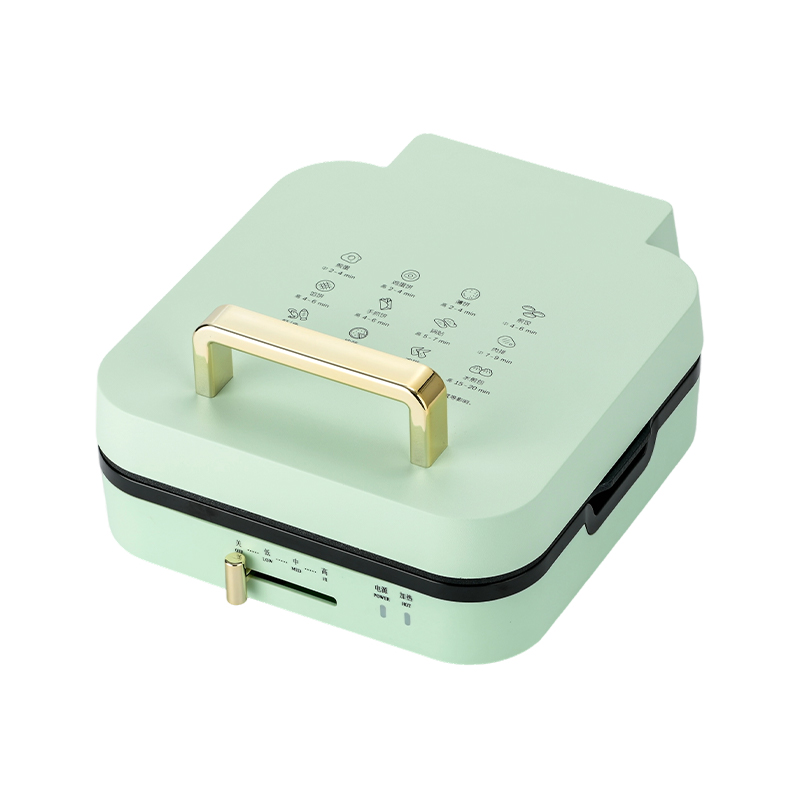
 Four-Slice Detachable Sandwich Maker and Open-Flat GrillA four-slice, three-level heat-controlled model for larger households, with removable plates and a 180° open-flat grill for sandwiches, waffles, and tabletop cooking.View Product →
Fixed, Removable or Interchangeable Plates
Removable plates cut cleaning to under two minutes and are worth the small price premium; fixed plates are cheaper and last about as long as the hinge does.
This is the specification that decides whether the appliance gets used on a Tuesday or quietly migrates to the back of a cupboard. Cleaning friction is real: a unit that needs five careful minutes at the sink after every sandwich tends to be reserved for weekends.
| Plate style | Cleaning time | Flexibility | Longevity | Best for |
|---|---|---|---|---|
| Fixed nonstick | 3 to 5 minutes, care needed around the hinge | One shape only | Plate usually outlives the electronics | Entry price points, simple use |
| Removable plates | 1 to 2 minutes, dishwasher safe on some models | One shape, easy to replace | Coating is a serviceable wear part | Daily family use |
| Interchangeable plates | 2 to 3 minutes plus storage handling | Sandwich, waffle and grill in one body | Highest, plates sold separately | Small kitchens that want one appliance, not three |
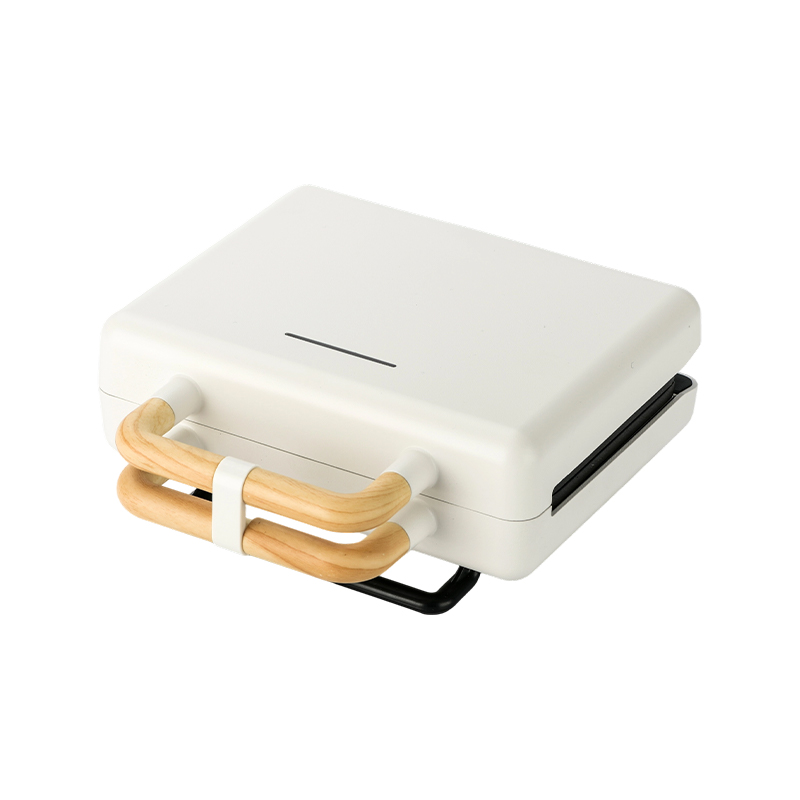
Wooden or wood-grain handles are not cosmetic only; they stay cooler than bare plastic in a hot kitchen and give a better grip when the lid is spring-loaded. A removable-plate model with a cool-touch handle is the combination most buyers settle on after comparing options.
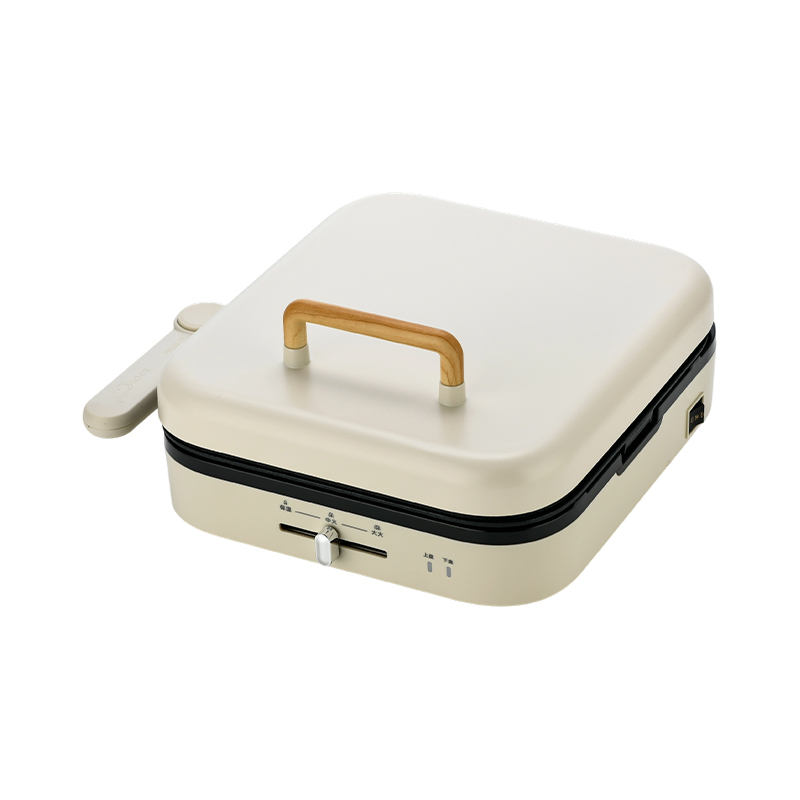
 Wooden-Handle Detachable Sandwich and Waffle MakerA compact detachable sandwich and waffle maker with a cooler wooden handle, one-click removable plates, and a floating hinge that accommodates different bread thicknesses.View Product →
Timers, Heat Control and the 180-Degree Hinge
A mechanical timer and a 180-degree hinge change daily use more than an extra hundred watts ever will.
Without a timer you are guessing, and guessing is how sandwiches go from golden to dark while you answer a message. A 15-minute mechanical dial costs very little to add and covers eggs, pancakes and reheating as well as sandwiches. It also survives far longer than a membrane keypad in a steamy kitchen.
The 180-degree hinge is the second high-value feature. Opened flat, a 28 x 28 cm unit becomes a small griddle for two eggs, a quesadilla or a batch of bacon, and the top plate no longer presses the filling sideways. Closed, the same hinge gives even pressure for panini. If counter space is tight, a vertical stand or a locking latch that compresses the unit for storage matters as much as the cooking area.
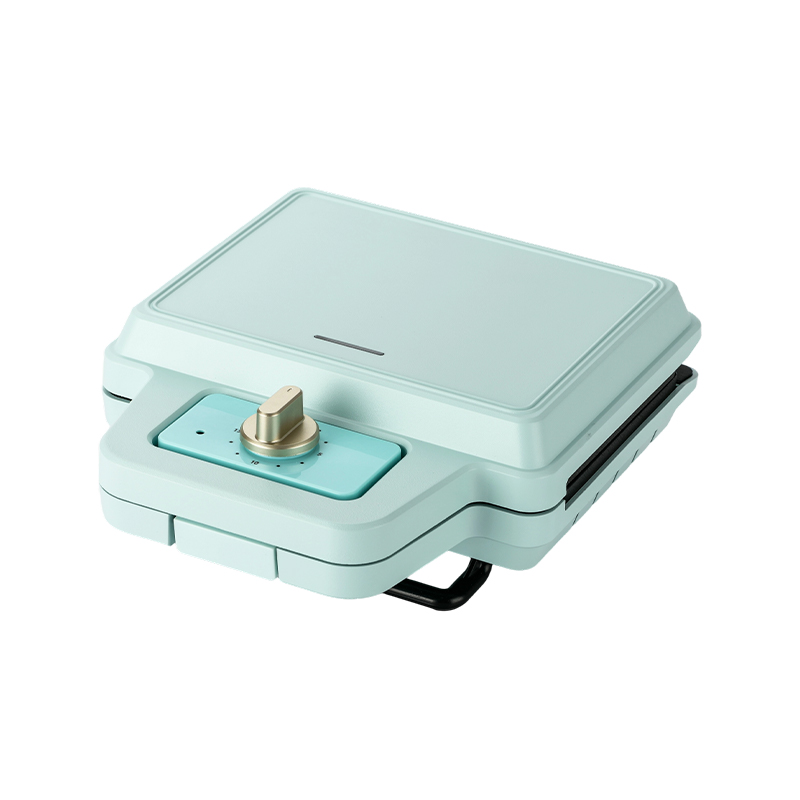
 Two-Slice Multi-Function Sandwich and Waffle MakerA compact two-slice maker with a 15-minute timer and interchangeable non-stick plates for sandwiches, waffles, grill items, and fish-shaped treats.View Product →
What to Check Before You Buy
Four things decide whether a sandwich maker ends up on the counter or in the cupboard: plate depth, hinge clearance, cleaning access and footprint.
- Plate depth of 2 to 3 cm. An egg plus cheese needs vertical room; shallow plates squeeze filling out of the sides and make a mess of the hinge.
- Hinge clearance when closed. Thick sourdough at 1.5 cm a slice plus 2 cm of filling is a common mismatch. Measure before ordering online.
- Cleaning access. Check whether the plates release, and whether the drip channel can be reached with a sponge.
- Rating label and plug. 120 V/60 Hz for North America, 220 to 240 V for Europe, the Gulf and most of Asia. A dual-voltage claim should be printed on the label, not just in the listing.
- Nonstick specification. Two-layer coatings are standard; a three-layer coating survives metal tongs and daily washing noticeably longer.
- Spare parts. Ask whether the plate, hinge pin and timer are available as service parts; a machine that cannot be repaired is a machine that gets replaced.
Sourcing a Breakfast Sandwich Maker for Your Brand
For private-label orders, plate tooling and the nonstick line set the real lead time, not the housing colour.
We build sandwich makers in Yuyao, Ningbo, in a 5,000 square metre plant with in-house mold, injection and assembly shops, and more than ten years of small kitchen appliance production behind it. That vertical setup matters to buyers because a new plate profile, a deeper egg ring or a revised handle can be cut, moulded and sampled without passing the project between three suppliers and losing a month to each handover.
Practical checks for any sourcing conversation, ours included:
- Ask for a plate drawing with the ring diameter and depth, not just a product photo.
- Request food-contact documentation for the coating, such as LFGB or FDA-compliant reports, plus CE and EMC declarations for European shipments.
- Confirm the sample approval criteria in writing: coating adhesion, hinge cycle count, timer accuracy and a drop test on the retail carton.
- Agree on packaging before tooling, because a four-slice carton is close to the size limit for many parcel networks.
Our own line ranges from single-slice units with a 15-minute timer to a four-slice model that opens flat, and the home sandwich maker range shares mounting points across models so a buyer can test two plate designs on one body. That flexibility is usually worth more than a small unit-price difference, because it shortens the path from sample to shelf.
Cleaning, Care and Safe Use
Wipe the plates warm, never hot, and never run the body under the tap with the plug connected.
- Unplug the unit and let it cool for about ten minutes; warm plates release residue far more easily than cold ones.
- Use a soft sponge with warm water and a little mild detergent; abrasive cream and metal scourers cut through the coating within months.
- Remove plates only when cool, and never immerse the main body, cord or plug.
- Store closed with a paper towel between the plates to protect the nonstick surface from knocks.
- Keep the cord away from the hot exterior, and place the unit on a dry, level surface with clearance above the lid.
Frequently Asked Questions
How long does a breakfast sandwich take in total?
Four to six minutes of cooking after a one to two minute preheat, so roughly seven minutes from a cold start. A 180-degree griddle setup takes a minute longer because the larger plate mass has to recover heat.
Can I use it without the egg ring?
Yes. Remove the middle plate and treat the unit as a clamshell press for grilled cheese, quesadillas, hash browns or reheated pizza. The ring is only needed for a whole egg.
Do I have to butter the bread?
A light coating of butter or oil on the outer faces gives colour and stops sticking. Dry bread on a dry plate will still cook, but it browns patchily and tends to tear when lifted.
What else can a sandwich maker cook?
Pancakes and omelettes in the ring, halloumi or tofu slices on the flat plate, and waffles on models with interchangeable waffle plates. Anything thicker than half the plate depth should be trimmed or halved first.
Is a removable-plate version worth the extra cost?
For anyone cooking more than twice a week, yes. The shorter cleaning cycle is the difference between routine use and occasional use, and the plates can be replaced when the coating wears instead of scrapping the whole appliance.
A breakfast sandwich maker is not a novelty gadget; it is a sequenced cooking tool. It replaces three pans, one burner and about ten minutes of attention with a single closed cycle, and it does that most reliably when the plate depth, hinge clearance and cleaning routine suit the way the kitchen is actually used.
If the goal is restaurant-style stack for a family of four, buy capacity and an opening hinge. If the goal is a fast weekday egg sandwich for one, a two-slice unit with removable plates and a mechanical timer will outlast two cheaper machines. Both decisions come down to the same three numbers: plate depth, wattage and cleaning time.